Tell us about the job
Takes about a minute. No obligation.
Homes in Carbon County, UT run heat about nine months a year, from September through May. A boiler running that kind of schedule puts its burner, heat exchanger, and ignition components through thousands of cycles before the season closes. Contractors repairing boilers here consistently find ignition system failures and heat exchanger fatigue as the presenting problems, because those parts carry the load every time the thermostat calls for heat. Seals and expansion joints wear against repeated pressure and thermal stress. A unit that reaches the end of a long heating season without a service visit has often been running degraded for weeks before the homeowner notices.
Piping runs, zone valves, and expansion tanks in a house from this era were often patched or partially swapped out as individual parts failed rather than replaced as a system. Half the homes in Carbon County, Utah were built in 1972 or earlier (2020-2024 ACS 5-year). That history of incremental repair means the components a contractor finds inside a boiler system here are frequently mismatched, and a part that fits the boiler's current specifications may sit against adjacent piping that was sized for something different. The diagnostic question is not whether the boiler itself is worn but whether the part a contractor sources today will function reliably in the distribution system around it.
The Parts of a Boiler a Contractor Checks First
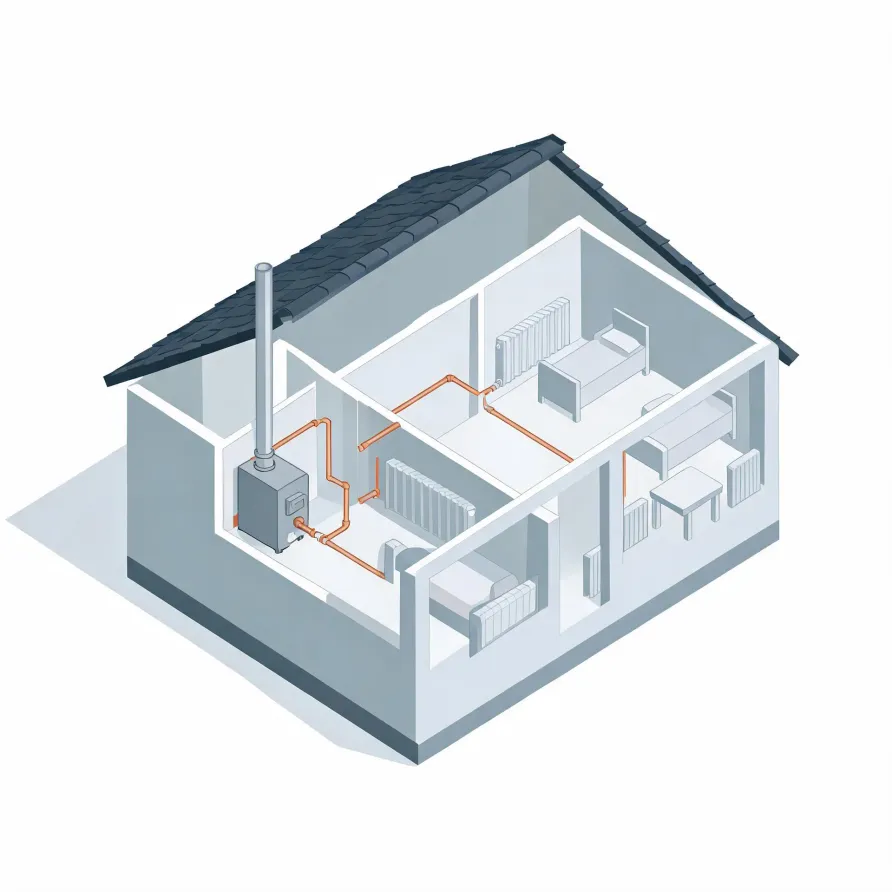
The boiler itself sits in a mechanical room, basement, or utility closet and is the piece a contractor goes to first. It heats water and pushes it through the system. When heat stops reaching a room or stops reaching the whole house, the boiler's burner, heat exchanger, or pressure controls are where a contractor starts looking.
Radiators or radiant floor loops are the delivery side, spread through the living spaces, and a problem with one zone often points back to a circulator pump or zone valve rather than the boiler itself. Expansion tanks and pressure relief valves sit close to the boiler and show their own failure signs when readings run outside normal range.
The drawing shows a representative layout, and a licensed contractor determines which components apply and what the actual condition is in your specific home.
Find a contractor in Carbon CountyCarbon County, Utah, by the numbers
46 severe weather events were recorded in Carbon County, Utah between 2015 and 2024.
NOAA National Centers for Environmental Information, Storm Events Database, bulk CSV export, events 2015-01-01 through 2024-12-31.Half the homes in Carbon County, Utah were built in 1972 or earlier (2020-2024 ACS 5-year).
U.S. Census Bureau, 2020-2024 American Community Survey 5-Year EstimatesCarbon County, Utah holds 9,669 housing units (2020-2024 ACS 5-year).
U.S. Census Bureau, 2020-2024 American Community Survey 5-Year EstimatesOwners occupy 67.9% of the occupied homes in Carbon County, Utah (2020-2024 ACS 5-year).
U.S. Census Bureau, 2020-2024 American Community Survey 5-Year EstimatesCodes & Standards Governing Boiler and HVAC Repair in Carbon County, Utah2 sourced rules and standards
Licensing Rules for HVAC Work in Carbon County, Utah
Utah’s contractor licence does not reach alteration, repair, remodelling or improvement of a building worth less than $7,000 in labour and materials together, counting every change and addition to the agreed work — though the plumbing and electrical trades are pulled back under licensure even below that figure.
Utah requires a state licence before engaging in a licensed construction trade or contracting activity, and HVAC contractor is one of the licence classifications the state issues.
Weather Stress on Heating Systems in Carbon County
Boilers work against the climate they sit in, and Carbon County's weather sets the pace for how hard that work gets. Repair demand follows from conditions, which is why local contractors track what the weather actually does here.
46 severe weather events, 2017–2024. Source: NOAA National Centers for Environmental Information, Storm Events Database.